Overview of data sources and processing of primary indicators
General overview of data sources including temperature, rainfall, wind, radiation, and sea level data.
General overview
ClimateVision uses automated data processing to generate climate indicators useful for infrastructure projects from global climate projections. The tool reproduces recognized methodologies using the latest scientific data to produce state-of-the-art local information about current and future climate.
This first part gives a short overview of the data source and methodology used for each indicator.
Average temperature projections
Data
Average temperature projections are based on simulation of future climate by 12 climate models from the Coupled Model Intercomparison Project phase 6 (CMIP6). These projections are a subset of the projections used in the Intergovernmental Panel on Climate Change's 6th assessment report.
The simulation point closest to the location of interest is extracted and the results are downscaled and corrected for bias using historical data from European Centre for Medium-Range Weather Forecasts's reanalysis as reference. ERA5 Land is used for in-land or coastal locations and ERA5 is used on offshore projects.
| Indicator | Projection | Reference |
|---|---|---|
| Average Temperature | CMIP6 tas (daily) | ERA5/ERA5 Land t2m (daily average computed from hourly data) |
Processing
The impact of climate change for a given decade is then evaluated by averaging corrected projections over 30 years centered on the decade (e.g., average temperature for the decade 2050 is computed based on climate simulations from 2040 to 2069).
Average rainfall projections
Data
Average rainfall projections are based on simulation of future climate by 12 climate models from the Coupled Model Intercomparison Project phase 6 (CMIP6). These projections are a subset of the projections used in the Intergovernmental Panel on Climate Change's 6th assessment report.
The simulation point closest to the location of interest is extracted and the results are downscaled and corrected for bias using historical data from European Centre for Medium-Range Weather Forecasts's reanalysis as reference. ERA5 Land is used for in-land or coastal locations and ERA5 is used on offshore projects.
| Indicator | Projection | Reference |
|---|---|---|
| Average Rainfall | CMIP6 pr (daily) | ERA5 pr (daily average computed from hourly data) |
Processing
Precipitation is processed using a specific correction procedure (see Precipitation special case chapter).
The impact of climate change for a given decade is then evaluated by averaging corrected projections over 30 years centered on the decade (e.g., average temperature for the decade 2050 is computed based on climate simulations from 2040 to 2069).
Average wind speed projections
Data
Average wind projections are based on simulation of future climate by 12 climate models from the Coupled Model Intercomparison Project phase 6 (CMIP6). These projections are a subset of the projections used in the Intergovernmental Panel on Climate Change's 6th assessment report.
The simulation point closest to the location of interest is extracted and the results are downscaled and corrected for bias using historical data from European Centre for Medium-Range Weather Forecasts's reanalysis as reference. ERA5 Land is used for in-land or coastal locations and ERA5 is used on offshore projects.
| Indicator | Projection | Reference |
|---|---|---|
| Average Wind Speed | CMIP6 sfcWind (daily) | ERA5/ERA5 Land u10 and v10 (daily average wind computed from hourly u and v component of wind at 10 meters) |
Processing
The corrected wind projections are subsequently used to derive renewable energy indicators.
Average shortwave radiation projections
Data
Average shortwave radiation projections are based on simulation of future climate by 12 climate models from the Coupled Model Intercomparison Project phase 6 (CMIP6). These projections are a subset of the projections used in the Intergovernmental Panel on Climate Change's 6th assessment report.
The simulation point closest to the location of interest is extracted and the results are downscaled and corrected for bias using historical data from European Centre for Medium-Range Weather Forecasts's reanalysis as reference. ERA5 Land is used for in-land or coastal locations and ERA5 is used on offshore projects.
| Indicator | Projection | Reference |
|---|---|---|
| Average Shortwave Radiation | CMIP6 rsds (daily) | ERA5/ERA5 Land ssrd (daily average ssrd computed from hourly data) |
Processing
The corrected shortwave radiation projections are subsequently used to derive renewable energy indicators.
Extreme temperature projections
Data
Extreme temperature projections are based on simulation of future climate by 12 climate models from the Coupled Model Intercomparison Project phase 6 (CMIP6). These projections are a subset of the projections used in the Intergovernmental Panel on Climate Change's 6th assessment report.
The simulation point closest to the location of interest is extracted and the results are downscaled and corrected for bias using historical data from European Centre for Medium-Range Weather Forecasts's reanalysis as reference. ERA5 Land is used for in-land or coastal locations and ERA5 is used on offshore projects.
| Indicator | Projection | Reference |
|---|---|---|
| Minimum Temperature | CMIP6 tasmin (daily) | ERA5/ERA5 Land t2m (daily minimum computed from hourly data) |
| Minimum Daily Temperature | CMIP6 tas (daily) | ERA5/ERA5 Land t2m (daily average computed from hourly data) |
| Maximum Temperature | CMIP6 tasmax (daily) | ERA5/ERA5 Land t2m (daily maximum computed from hourly data) |
| Maximum Daily Temperature | CMIP6 tas (daily) | ERA5/ERA5 Land t2m (daily average computed from hourly data) |
Processing
Return levels for a selection of return periods are then computed using extreme value analysis.
Extreme rainfall projections
Data
Extreme rainfall projections are based on simulation of future climate by 12 climate models from the Coupled Model Intercomparison Project phase 6 (CMIP6). These projections are a subset of the projections used in the Intergovernmental Panel on Climate Change's 6th assessment report.
The simulation point closest to the location of interest is extracted and the results are downscaled and corrected for bias using historical data from European Centre for Medium-Range Weather Forecasts's reanalysis as reference. ERA5 Land is used for in-land or coastal locations and ERA5 is used on offshore projects.
| Indicator | Projection | Reference |
|---|---|---|
| Maximum Daily Rainfall | CMIP6 pr (daily) | ERA5/ERA5 Land pr (daily average computed from hourly data) |
Processing
Precipitation is processed using a specific correction procedure (see Precipitation special case chapter).
Return levels for a selection of return periods are then computed using extreme value analysis.
Extreme wind projections
Data
Extreme wind projections are based on simulation of future climate by 12 climate models from the Coupled Model Intercomparison Project phase 6 (CMIP6). These projections are a subset of the projections used in the Intergovernmental Panel on Climate Change's 6th assessment report.
Since extreme wind speeds must be computed on shorter time steps than those of the climate models, an extrapolation method is used.
The simulation point closest to the location of interest is extracted and the results are downscaled and corrected for bias using historical data from European Centre for Medium-Range Weather Forecasts's reanalysis as reference. ERA5 Land is used for in-land or coastal locations and ERA5 is used on offshore projects.
| Indicator | Projection | Reference |
|---|---|---|
| Wind Speed | CMIP6 sfcWindmax (daily) | ERA5/ERA5 Land u10 and v10 (daily maximum total wind computed from hourly u and v component of wind at 10 meters) |
Extrapolation methodology
ClimateVision provides an evaluation of the local evolution of maximum wind speed over 10 minutes, 1 minute and 3 seconds throughout the 21st century.
Most climate projections are available with monthly, daily, 6-hour or 3-hour time steps. As a result, an extrapolation is necessary to calculate wind speed on a time step of a few minutes to a few seconds from much coarser data. The maximum wind speed for a given return time is then calculated from the downscaled data using the extreme value analysis methods detailed in the previous chapter.
In addition, these projections are typically for sustained wind speeds and do not consider short term phenomena, like gusts. Extreme gusts occur due to a variety of short-lived phenomena that climate models are not designed to capturexvi. The ratio of maximum gust wind speed to mean wind speed can be largexvii.
Industrial standards, both ISOxviii and APIxix, provide a method for estimating the wind speed from measurements taken at different heights and/or time steps.
Knowing the wind speed at height and time step , first the mean wind speed for the same time step at a different height is evaluated with the following formula:
Then the wind speed corresponding to an average wind period is given by:
Where is the turbulence intensity at level given by:
Processing
To improve the quality of the results, the evaluation of extreme winds is based on projections with a daily step. The projections used are the daily maximum wind speeds, corrected to the daily maximum wind speeds from the ERA5/ERA5-Land reanalysis. The instantaneous projections of maximum wind speeds are, after correction, homogeneous with hourly wind speeds.
Return levels for a selection of return periods are then computed using extreme value analysis. Extrapolation to finer temporal resolutions is then performed on the previously computed extreme wind return values.
Sea level rise
Data
Sea level projections are from the Intergovernmental Panel on Climate Change's 6th Assessment Reportxx retrieved from NASA's Physical Oceanography Distributed Active Archive Center.
The results are displayed for the valid data point closest to the location of interest.
Medium and low confidence projections
The AR6 features two sets of projections for sea level:
- "Medium confidence" projections include only processes that can be projected skillfully with at least medium confidence,
- "Low confidence" projections consider processes whose quantification is highly uncertain regarding the timing of their possible onset and/or their potential to accelerate sea level rise.
The differences between the two projections lie primarily in the methodology used to assess the contribution of the Antarctic and Greenland ice sheets to sea level rise.
Both projections are usually similar in the short term, but low confidence projections tend to be higher starting from the second half of the 21st century:
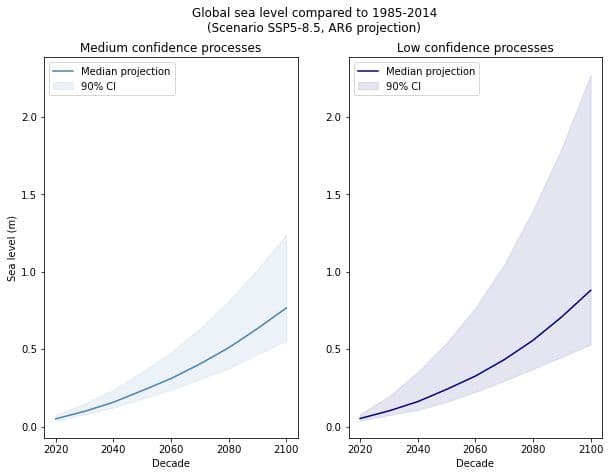
For example, by 2100 in a high emission scenario (SSP5-8.5) the median projection for global sea level rise compared to 1985-2014 level is 0.766 meters in the medium confidence projection and 0.88 m in the low confidence projection.
Uncertainties are also significantly higher: under the same assumptions, the upper bound of the 90% confidence interval is 1.242 m in the medium confidence projection but 2.274 m in the low confidence projection.
The most appropriate projection depends on the lifespan of the project, on its ability to adapt to a faster-than-expected sea level rise, and on the level of risk that is deemed acceptable.
According to the IPCCxxi,xxii, stakeholders that are risk tolerant (e.g., those planning for investments that can be easily adapted to unforeseen conditions) may prefer to use projections in the medium confidence range while those with a low risk tolerance (e.g., those planning for long-term investment in critical infrastructure) may wish to consider sea level rise that falls within the high-end scenario.
Since both cases can occur, ClimateVision provides projections from the two sets.
Processing
The original dataset contains sea level projections relative to 1985-2014 level on a 1×1 degree global grid and on 1016 tide gauge locations.
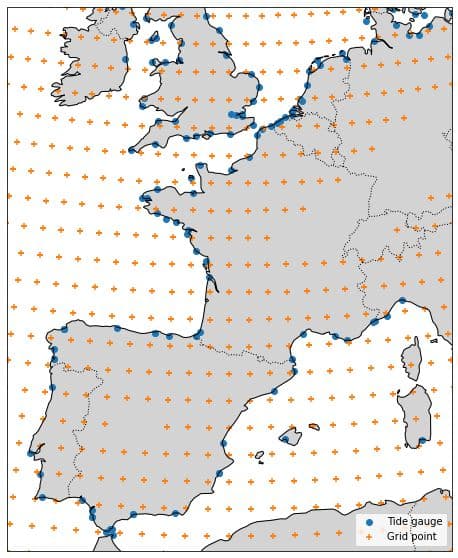
The results reported correspond to the closest data point to the location of interest.
To remain consistent with the other indicators in the report, the median projection and 90% confidence interval are presented between 2020 and 2080.
Extreme wind wave height
While they evolve with climate change, waves are not among the variables simulated by global circulation models. They are not included in the variables reported in the CMIP5 and 6 projects. The study of the wave evolution in the future typically requires an additional simulation stage to compute heights, periods and directions from climate model outputs, such as wind projections.
However, some wave projections are available from several sources, for example: COWCLIP, CSIRO or Copernicus. These projections have been used in many studies to quantify the impact of climate change on sea state, including studies of extreme wavesxxx. Such publications regularly highlight significant uncertaintiesxxxi, often greater than the projected evolutionxxxii.
Wave projections using the new climate models and emission scenarios from the 6th IPCC report are less common and do not yet seem to have been consolidated at the international level.
Data
ClimateVision provides local waves data extracted from the first CMIP6 projections available and acquired directly through their producers:
- The Australian CSIROxxxiii recently published global wind-wave projections for a small subset of 2 scenarios (SSP1-2.6 and SSP5-8.5) and 8 models. The spatial resolution of this set of projections is 0.5° with a 3-hour time step. Projections are available for only one value of the wind-drag coefficient (CDFAC): 1. The projections used in this report are based on a coefficient of 1.
A frequent review of publications is carried out to progressively integrate other projections based on the CMIP6 models and scenarios once they are published.
Extreme waves projections are based on WAVEWATCH III simulations forced by future climate from 8 climate models of the Coupled Model Intercomparison Project phase 6, retrieved from the Australian CSIRO. These significant wave height projections use a 3-hour time step that are aggregated into daily maximum significant wave height series.
The SSP2-4.5 scenario is not available. Only the 2071 to 2100 period is available for the projections. The valid data point closest to the location of interest is extracted.
| Indicator | Projection | Reference |
|---|---|---|
| Significant Wave Height | CMIP6 hs (daily significant wave height maximum computed from 3-hourly hs) | ERA5 swh (daily significant wave height maximum computed from hourly swh significant height of combined wind waves and swell) |
Methodologies
Significant wave height
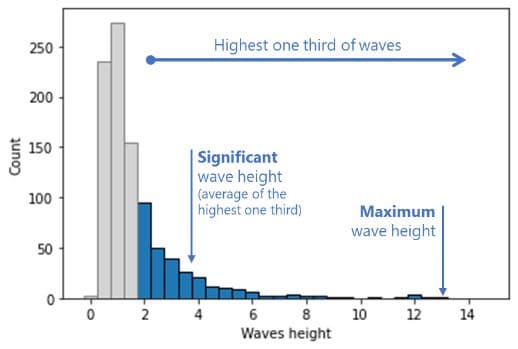
The significant wave height () is a statistical measure of the height of waves during a given period. It was originally defined as the average height of the highest one-third of waves. Currently, significant wave height is often taken as 4 times the standard deviation of the water surface elevation series, typically over a period of approximately 30 minxxiii,xxiv.
The maximum wave height () is the maximum height of an individual wave for a given return period.
The wave period can be evaluated in different ways. The most common definitions are:
- Spectrum peak period (): the period corresponding to the peak of the spectrumxxv,
- Mean wave period (): the wave period corresponding to the mean frequency of the spectrumxxvi,
- Mean zero crossing wave period (): the time obtained by dividing the record length by the number of down crossings (or up crossings) in the recordxxvii,xxviii,
Other existing definitions include the significant wave period (approximately equal to the spectrum peak period) and the wave energy period (corresponding to the weighted average of the wave energy).
Wave characteristics are largely dependent on atmospheric parameters and evolve with climate change. For example, the IPCC's AR6 reports an increase in wave heights of order 0.5 cm per year, most pronounced in the Southern Ocean. But this trend is affected by significant uncertainties and rated only "medium confidence"xxix.
Evaluation of the maximum wave height
In addition to the significant wave height derived from models' outputs, the maximum wave height is evaluated using the Rayleigh distributionxxxiv.
Assuming that the elevation of sea surface has a gaussian distribution, the maximum values of the elevation (i.e.: the maximum wave height) should follow a Rayleigh distribution. In that case the probability that waves reach a height is:
Where is the significant wave height.
As a result, the wave height associated with the probability is:
For instance, the value of the last centile of wave height is:
A simplified version of this formula is frequently used for off-shore structure calculation:
This formula matches to the Rayleigh distribution with an exceedance probability of 0.1%.
Evaluation of the spectrum peak period
As the extremes of significant wave heights are calculated from a statistical model, waves of this height do not necessarily exist in observations or projections. As a result, the period associated with these extremes must be estimated theoretically.
The wave period associated with significant wave height extremes is calculated using the following formula:
Where is the significant wave height and coefficients and are adjusted using the observed extremes.
However, the fit can sometimes be considered inconclusive with a low coefficient of determination ( close to 0). In such cases, the approach based on Goda's formulaxxxv has been used to calculate the peak wave period, but shows no improvement compared to a poor fit on the local data.
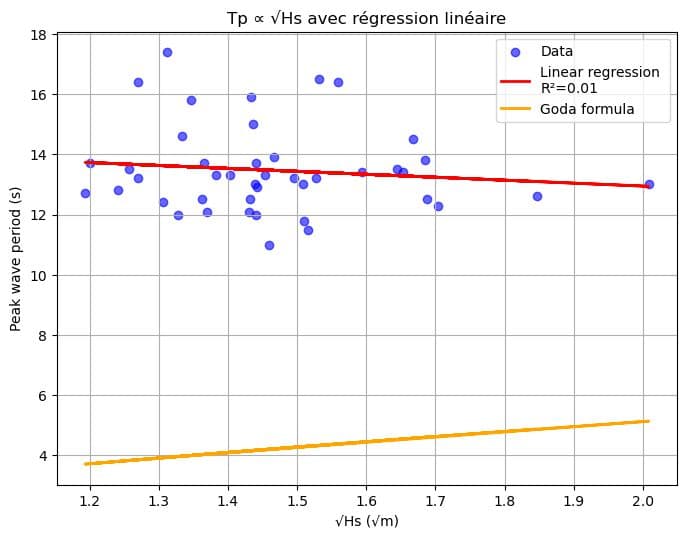
A more detailed investigation will be conducted in future versions.
Processing
Return levels for a selection of return periods are then computed using extreme value analysis. The spectrum peak period is then evaluated for each extreme significant wave height return level.